


Returning TurboTax users, already familiar with the platform, were forced to go through a full onboarding flow built for first-time filers. This led to redundancy, friction, confusing product recommendations, and high drop-off, particularly between authentication and income entry, and at product selection stages.

Streamlining onboarding for returning users
Company
Intuit TurboTax
Project
Returning user onboarding
Role
User research • Strategy • UX/UI


+1 pp lift
~$4.5M impact
Should returning users be subject to the same onboarding process as new users?
Scope
- User research
- Strategy
- UX/UI
Measured success
- Improved Authentication to Income by a 103 Index to control

Insights from early research
User research and analytics revealed three critical pain points:
Redundant flows
Returning users were subjected to the same onboarding process as new users, creating unnecessary friction and fatigue.
Lack of personalization
Regardless of their cohort, first-year returner, veteran, or life-event filer, all users followed a single repetitive flow that failed to address their unique needs.
Fear of the unknown
Users expressed anxiety about refund outcomes, particularly if they anticipated a lower refund or balance due compared to prior years.
The task
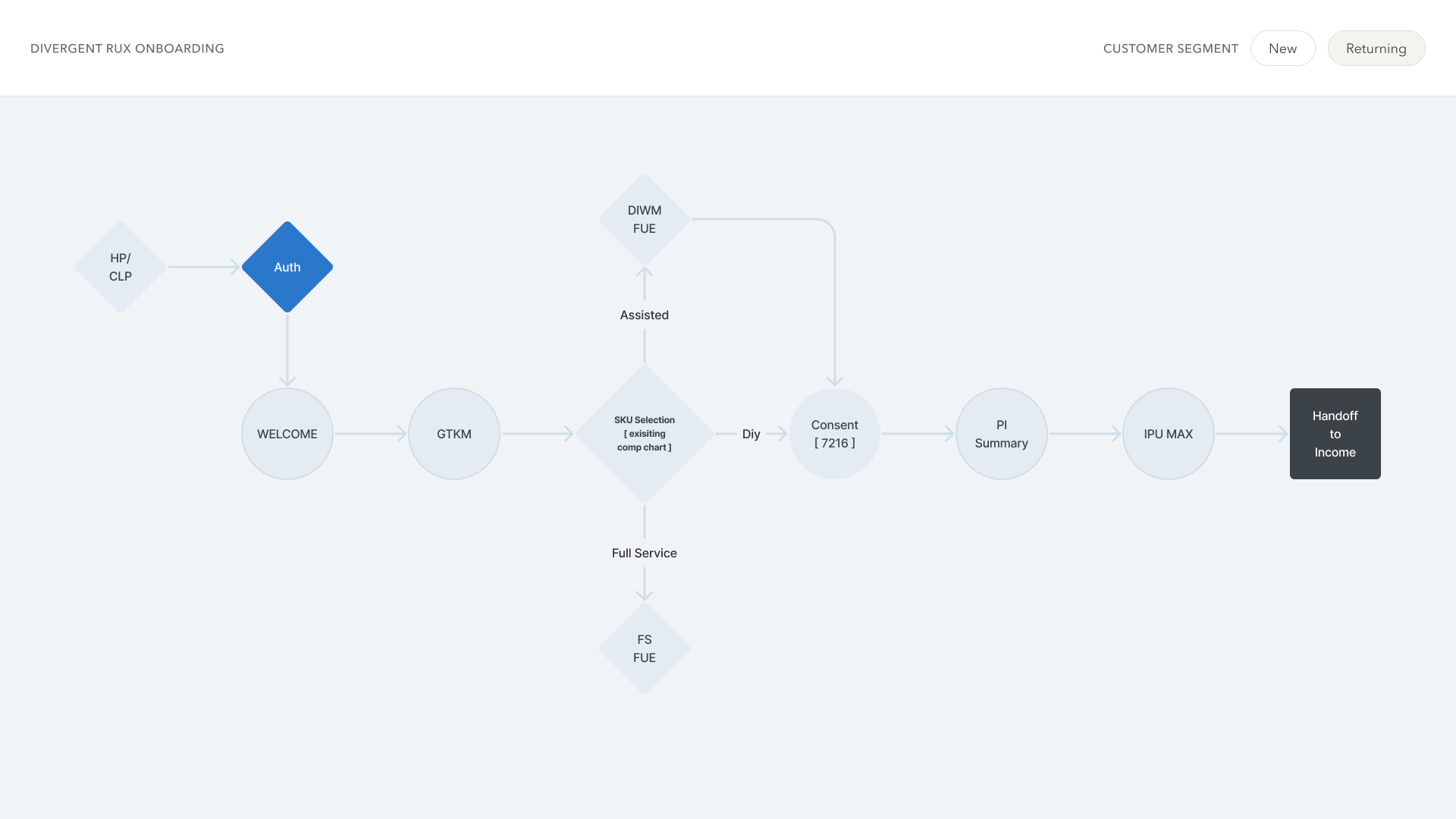
My objective was to redesign onboarding for returning users to skip redundant steps, surface relevant life‑change prompts, establish trust with tailored product suggestions, and improve the conversion rate from Auth → Complete.

RITE testing & validation
I designed eight initial concepts and narrowed them to three high-potential prototypes for user testing. I partnered with our research lead to run two rounds of Rapid Iterative Testing and Evaluation (RITE) with 12 returning do-it-yourself and assisted users. These sessions validated my direction and directly informed key decisions across the updated onboarding experience.


Key findings
- Returning customers expressed frustration with repetitive questions and unclear product recommendations, which led to confusion and diminished trust in TurboTax.
- There was a strong desire for a system that could recognize life changes and suggest personalized product choices based on those changes.
- Customers valued efficiency and personalization, seeking a streamlined process that would remember their information year-to-year and minimize the time spent onboarding.
Updated user flow based on our findings
Project outcome
+1 pp lift
~$4.5M impact
Results and impact
A2I (Auth to Income) and A2C (Auth to Complete) both improved among returning users in the first 2 weeks after launch. Participants in follow-up sessions consistently cited less manual entry and a flow that recognized their prior-year data as the reasons the experience felt faster.
Insightful learnings
Personalization is only as good as the data underneath it. The ML models driving the personalized journey were the deciding factor in whether the experience felt tailored or merely automated, and accuracy problems surfaced as friction long before they surfaced as model metrics. Next steps for the team were refining those models and identifying additional points in the flow where prior-year data could remove a step.
The success of this project was a testament to the dedication and collaboration of my team
Special thanks to Sai Manohar Nethi for navigating through complex edge cases, and to JP Phousirith, Joey Hu, Cole Bickford, Norman Bell, and Erik Wirtz for their relentless testing efforts. Appreciation also goes to Jing Yuan, Shankar, @tkang1, and @jhsu3 for their instrumental role in developing the RedOn Model, and to Prageesh Gopakumar, Patrick Tsui, Danh Dang, and Will Jang for their invaluable PD support. This project was a collective effort, and its success reflects the hard work and innovation of the entire team.
